Caddy - Second Phone Number
- 4.6
- Rating
- 100.00K
- Installs
- Free
- Price

 Analysis by App-foxy
I approached Caddy - Second Phone Number as a practical communication tool rather than another app I would open once and forget. Developed by 800.com, LLC, this free iOS and Android app is aimed at people who need a business identity for calls without carrying a separate work phone. Its central promise is easy to understand: help a solo business owner avoid letting an unanswered call become a lost opportunity.
That focus gives it a clear audience. If you freelance, run a small service business, sell products independently, or simply want to keep customers away from your personal number, Caddy makes sense immediately. It sits in the communication category, carries an Everyone age rating, and has reached over 100 thousand installs. More importantly, the app feels built around a recurring problem: personal phones are convenient, but mixing clients, friends, family and unknown callers on one line becomes tiring very quickly.
My overall impression is positive, but not blindly enthusiastic. The first few days are the easy part because the idea is useful from the moment you recognize the problem. The harder question is whether a second-number app continues earning its place after the novelty disappears. In my experience, the answer depends on whether you regularly receive work calls and whether you are comfortable treating the app as part of your daily business routine.
You May Also Like

 Blood Strike: 2.5 Anniversary
Blood Strike’s Loadouts Turn Every Drop Into a Tactical Gamble
A close look at Blood Strike’s custom loadouts: how fast access to signature weapons reshapes its battle royale rhythm, rewards preparation, and narrows the gap between fights.

 Pandora - Music & Podcasts
Pandora’s Music Is Easy to Start, but Harder to Recover
Pandora’s strength is its low-effort path from a seed to a station. Its weak spot is how much confidence it asks you to place in connection, setup, and quiet recovery.

 8 Ball Pool
 Is Built on Rivalries, Rematches, and Routine
A close look at the rivalries, rematches, shared routines, and unanswered safety questions that turn a quick pool match into a persistent mobile community.

 Samsung Music
’s Quiet Strength Is Playing What You Already Own
Its reach comes less from spectacle than from dependable access to a personal library. That simplicity is both the app’s strongest retention engine and its ceiling.

 AccuWeather: Weather Radar
AccuWeather Review: A Quick, Clear Forecast for Everyday Decisions
For everyday plans, the best forecast is the one you can understand quickly. AccuWeather makes rain timing, radar, and local conditions easy to act on, with a few trade-offs.

 Hill Climb Racing
Why Hill Climb Racing Still Turns Crashes Into One More Run
A tiny car, a bumpy hill and one more upgrade: Hill Climb Racing keeps resurfacing because its simple chaos makes every near-miss feel personal.
More From Our News Desk
View All News


What the first week feels like
The strongest part of Caddy is how quickly its purpose becomes practical. I can imagine using the separate number on a business card, a contact page, an online listing or a message to a new customer, while keeping my private number reserved for people I already know. That small separation changes how I answer calls. An incoming call on the Caddy line has a different context before I even pick it up.
For a solopreneur, this is more valuable than it may sound. A missed call from a potential customer is not just a notification; it may represent a job that goes to someone else. Caddy's AI-focused business phone positioning is therefore more relevant to a self-employed person than to someone who only wants a spare number for occasional sign-ups. The app is trying to turn a personal smartphone into a more deliberate front door for a small business.
I also like the psychological boundary created by a second number. Without one, I tend to glance at every call and wonder whether it is personal, work-related or spam. With a dedicated business line, I can make a quick decision about when to answer and when to return calls later. That is a modest workflow improvement, but it is the kind that can make a phone feel less intrusive during evenings and weekends.
The first-week appeal is strongest for someone starting a service business. Imagine a cleaner, tutor, photographer or repair specialist posting an advertisement. Using a personal number may feel too exposed, while buying another handset is unnecessary. A separate line lets that person test demand, speak with prospective customers and keep private contact details out of public-facing places. The app does not need to replace every communication tool to be useful; it only needs to make that first point of contact more manageable.
There is also a useful distinction between a second number and a full customer-management system. Caddy is more approachable when I think of it as the phone layer of a small operation, not as a complete replacement for scheduling, invoicing or customer relationship software. That expectation matters. Someone who wants a focused business calling experience may appreciate its simplicity, while a growing team may quickly need tools outside the app.
The app has an average rating of 4.6 from around 1.7 thousand ratings, which suggests that the basic idea resonates with many users. I would not treat that number as proof that it fits every business, though. Communication apps are highly personal: the value depends on call volume, customer expectations and whether a user actually wants to maintain a separate work identity.
Where the AI angle helps, and where I stay cautious
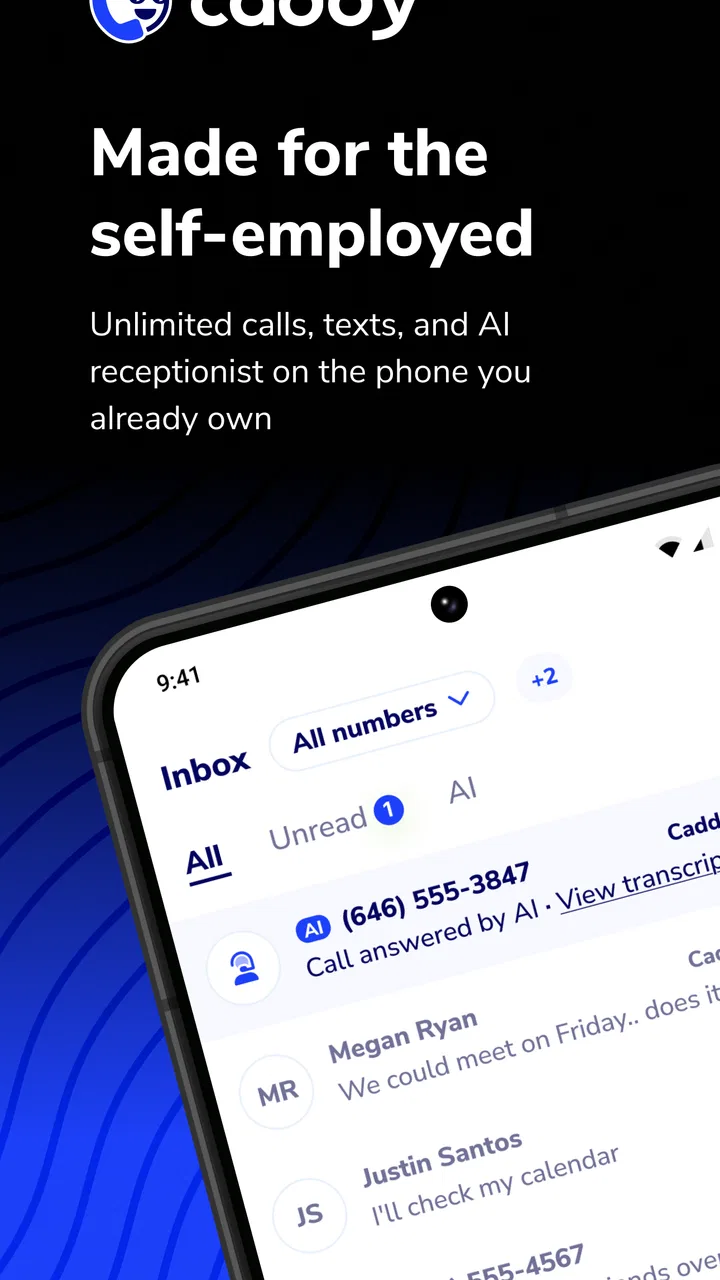
The AI positioning is attractive because small operators often cannot answer every call while working. A business owner may be driving, with a client, carrying equipment or already speaking to someone else. In that situation, a phone experience that helps reduce the damage from missed calls is more useful than a simple extra number sitting silently in the background.
At the same time, I would not install Caddy expecting artificial intelligence to remove the need for judgment. A caller may have a complicated request, use unusual terminology or need a personal response. I would still review how the app handles business communication and make sure important customers can reach me directly when necessary. The practical benefit is less about handing over the entire business and more about giving a one-person operation a little breathing room.
My best early tip is to decide what the number is for before sharing it widely. If I use it for every kind of inquiry, the line can become as chaotic as my personal number. If I reserve it for genuine business contacts and publish it consistently, the separation remains meaningful. This is one of those apps where a small setup decision affects the experience more than a flashy feature does.
Why it can remain useful month after month
The lasting value of Caddy comes from repetition. A second business number is not exciting after a few weeks, and that is actually a good sign. The app earns its place when it becomes a dependable part of how I advertise, answer customers and protect personal time. Its usefulness is measured in fewer awkward explanations and cleaner boundaries rather than in how often I admire the interface.
For a freelancer, the number can remain attached to a business identity even when the workday changes. For a side-business owner, it offers a way to keep customer conversations separate from family and friends. For someone testing a new service, it can provide a more professional contact point without immediately committing to another physical phone. These are recurring needs, not one-time experiments.
I find the separation especially valuable when a business changes direction. A personal number may have been shared with old clients, marketplace buyers and casual contacts over several years. Starting again with a dedicated line gives me a cleaner way to decide who receives business access. It also makes it easier to stop publicizing a number if a particular project ends, rather than having to change the number used by everyone in my personal life.
There is a habit component here. I would need to check the business line regularly, return calls in a consistent window and make sure customers know how to use it. Caddy cannot create responsiveness by itself. It can organize the entry point, but the owner still has to build the routine behind it. In that sense, the app rewards disciplined users more than passive users.
The free price makes trying that routine less intimidating, although the presence of in-app purchases ranging from around ten dollars to around three hundred dollars per item means I would examine the upgrade path carefully before building a business around paid capabilities. I would begin with the free experience, identify the exact problem I need to solve and only then consider spending money. A business tool should justify its recurring role through saved time or retained opportunities, not simply through the promise of being more advanced.
That trade-off becomes important when comparing Caddy with the usual alternatives. A second physical phone creates a very clear boundary, but it adds hardware, charging and another device to carry. A standard carrier add-on may feel familiar, yet it may not offer the same business-oriented experience. A general virtual-number service can be flexible, but may feel designed for a wider range of use cases rather than a solo operator trying to manage calls simply. A full business phone platform may offer deeper administration, but it can be excessive for one person.
Caddy's likely sweet spot is between those extremes. It is more intentional than using a personal number, less cumbersome than carrying two phones and potentially more approachable than adopting a large business communications suite. That does not make it the best option for everyone. It makes it a focused option for people whose main need is a separate business presence on the phone they already use.
The everyday workflow I would use
My preferred routine would be to publish the Caddy number wherever customers first encounter the business, then keep my personal number for established contacts. During working hours, I would treat calls to the business line as a queue of possible work. Outside those hours, I would avoid feeling obligated to answer immediately unless the situation genuinely required it.
For a mobile professional, the workflow could be even more useful. A landscaper might receive inquiries while operating equipment, or a photographer might be at an event and unable to answer. Rather than exposing a private number and letting every call interrupt the day, the business line gives customers a consistent route while preserving some control over attention.
Another non-obvious benefit is clarity when reviewing contacts later. If a new number appears on my phone, the business identity tells me why I may know it and what kind of response it deserves. That reduces the mental sorting involved in a mixed call history. It is not a dramatic automation feature, but it can make a busy solo operation feel less improvised.
I would also use a short, consistent explanation when giving the number to customers: this is the business line, while my personal number is reserved for private contacts. Setting that expectation early can prevent customers from assuming that every call will be answered instantly. The app supports the boundary, but communication about the boundary still matters.
Maintenance, friction and the risk of fatigue
The main maintenance burden is behavioral rather than technical. A second line only helps if I remember to monitor it. If I ignore notifications, forget to return calls or fail to update customers when my availability changes, the separate number becomes another inbox. For a person already struggling with too many apps, Caddy could add one more place to check instead of simplifying the day.
This is why I would not recommend it automatically to someone who receives very few business calls. If most customers contact me through email, messaging platforms or a booking service, an extra phone identity may not create enough value. In that case, a simple contact form or a single well-managed channel could be easier. Caddy is strongest when voice calls are still central to winning or serving customers.
There is also a possible fatigue problem with AI-assisted communication. Some customers want a direct conversation, especially when they have already tried to explain an issue elsewhere. If the app's business-phone experience becomes a barrier rather than a bridge, I would need to make sure there is an obvious path to a human response. The more personal or urgent the work, the less comfortable I would be relying entirely on automated handling.
Another source of fatigue is the temptation to treat the business number as an all-purpose shield. A separate line can protect privacy, but it does not automatically stop unwanted calls, repeated follow-ups or customers who expect immediate availability. I would still need clear operating hours, sensible contact practices and the willingness to decline work that is not a good fit.
Cost is another point to watch over time. The app itself is free to download, but the in-app purchase range is broad enough that I would not assume every useful capability is included at no cost. Before upgrading, I would ask a simple question: will this paid option help me answer more reliably, organize calls better or win enough work to cover the expense? If the answer is vague, I would keep the setup simple.
The current version is 1.17.0, and the app supports devices running at least iOS or Android version 9. That makes it accessible to people who are not using the newest phone, but I would still keep the app updated as part of normal maintenance. Communication tools are especially sensitive to compatibility and notification behavior, so an old installation is not where I would want to discover a problem during a busy workday.
Privacy expectations also deserve a realistic mindset. A business number reduces the need to publish my private number, which is valuable, but it does not make communication anonymous or consequence-free. I would be selective about where I post the number, avoid placing it on irrelevant public pages and think carefully before using it for every online transaction. The best privacy improvement comes from controlled sharing, not merely from having a second line.
Who should choose it, and who should skip it
I would recommend Caddy to a solo professional who receives customer calls, wants a separate public-facing number and does not want to carry another handset. It is also a sensible trial for someone launching a small service and trying to look organized without adopting a complicated business stack. The free entry point lowers the risk of testing whether a dedicated line changes daily communication.
I would be more cautious for a team. Once several people need access, shared responsibility, detailed call routing or more formal administration, a larger business phone service may be the better investment. Caddy can still be part of an individual workflow, but I would not assume that a solo-focused app will cover every need of a growing company.
I would also skip it if I dislike phone calls altogether or if my customers already prefer text and email. A second number cannot make an unsuitable communication channel suddenly efficient. Likewise, someone who wants a completely separate physical device may feel more comfortable with a second phone, despite the extra inconvenience.
Before committing, I would answer four practical questions. Will customers actually call me? Can I check the business line every day? Do I want to separate working hours from private time? And am I willing to review any paid features rather than assuming they are necessary? If the answer to all four is yes, the app has a credible chance of becoming a durable tool rather than a short experiment.
My long-term verdict
After the initial appeal fades, Caddy's value rests on a simple but important idea: a business phone identity can make a one-person operation feel more manageable. I like that it addresses a specific pain point instead of asking every small business owner to adopt a complete communications platform. The separate line can protect personal contact details, clarify incoming calls and give customers a more appropriate way to reach the business.
Its limitations are equally clear. The app does not remove the need for follow-up, availability rules or good customer service. AI assistance should be treated as support rather than a substitute for judgment, especially when a caller has a complicated or sensitive request. The second line can also become another chore if I do not build a reliable checking habit.
With over 977 reviews and an Everyone rating, Caddy has attracted meaningful attention for a relatively focused communication app. I see that as encouraging, but my recommendation would still depend on the user's working pattern. Someone who regularly risks losing work because calls go unanswered is likely to notice ongoing value. Someone who rarely uses voice calls may find that the extra line creates more maintenance than benefit.
For me, the app earns lasting space when it is used deliberately: publish the business number, keep personal contact private, check the line at planned times and review paid choices based on a real business need. Used that way, Caddy - Second Phone Number is not just a novelty or a spare contact detail. It becomes a small piece of operating discipline for a solo business.
My final recommendation is therefore favorable with conditions. I would try it if I were a freelancer, independent seller or service provider who needs a professional calling boundary without carrying another phone. I would choose a more comprehensive business phone system for a team, and a simpler channel for a business that rarely handles calls. For the right user, Caddy's recurring value is not spectacular; it is practical, repeatable and easy to feel whenever a work call arrives without exposing a private number.
FAQs for Caddy - Second Phone Number
01What is Caddy - Second Phone Number used for?
Caddy - Second Phone Number is designed to provide an additional phone number on your mobile device without requiring another physical SIM card. It can be useful for separating personal and business communications, registering with online services, managing classified advertisements, or keeping your primary number private when contacting people you do not know well.
02Does Caddy provide a real phone number for calls and text messages?
The app is intended to offer a secondary number that can be used for supported calling and messaging features, but availability may depend on your country, subscription plan, and local telecommunications restrictions. Before downloading or paying, check whether incoming calls, outgoing calls, SMS, verification messages, voicemail, and international communication are supported in your region.
03Is Caddy - Second Phone Number free to use?
Caddy may allow users to download the app and explore certain features at no initial cost, but a second phone number and extended communication functions can require a subscription, credits, or in-app purchases. Pricing and included services may vary by location and plan, so review the current offer in the App Store or Google Play before committing.
04Can I use the Caddy number for account verification and two-factor authentication?
A secondary number may work with some websites and applications, but it should not be assumed to support every verification system. Certain services block virtual, temporary, or VoIP numbers, while others may require a mobile number from a specific carrier. If the number is important for banking, recovery, or two-factor authentication, keep a dependable alternative available.
05Is my personal information and communication private when using Caddy?
Caddy can help avoid sharing your primary number, but using a second-number service does not automatically make communication completely anonymous. Calls, messages, account details, device information, and payment data may be processed according to the provider’s privacy policy. Read the permissions, terms, retention practices, and privacy documentation carefully before using the app for sensitive conversations.
Pros
- Keeps your personal number private when calling or texting.
- Useful for separating work
- dating
- and personal communications.
- Simple interface makes switching between numbers quick.
- Supports voicemail for missed calls and incoming messages.
- Can be used while traveling without changing your main SIM number.
Cons
- Requires a subscription for continued access to many core features.
- Availability and pricing may vary by country or region.
- Call and message quality depends heavily on your internet connection.
- A second number may not work with every verification service.
- Background calling can increase battery and mobile data usage.

Caddy - Second Phone Number
Gallery